Heavy haul trucking companies in the US: an honest comparison
Seven carriers that move oversize and overweight freight across the lower 48, what each one is actually good at, and how to check any of them before you book.
For superloads and multi-axle work, Bennett, Landstar, ATS and TFI (Daseke) have the equipment and permit teams. For freight that is heavy and dense but stays within legal width and height, a small open-deck carrier is usually faster to deal with and cheaper. Whichever you pick, check the carrier's USDOT number on FMCSA SAFER before you book.
Most lists like this one are published by a carrier hoping you will call them. This one is too, so read it that way: GTI Transport wrote this page. We have put ourselves first below because it is our website, and we have been straight about where we fit and where we do not. Every carrier here is listed with its USDOT number so you can check any claim on this page against the public record rather than taking our word for it.
What actually separates heavy haul carriers
Fleet size gets quoted a lot and tells you less than you would think. Four things matter more:
- Permits and routing. Does the carrier do this in-house, or farm it out? A load past legal dimensions needs a permit from every state it crosses, and some are valid only in daylight or on set days.
- The right equipment for your load. A nine-axle configuration and a 53 ft flatbed solve different problems. Paying for a lowboy you did not need is as expensive as booking a trailer that cannot carry the load.
- Verifiable safety and insurance. Authority, insurance filings and roadside inspection history are public on FMCSA SAFER. Check them.
- Who answers the phone. When a delivery window moves, you want the person who knows your load, not a queue.
1. GTI Transport
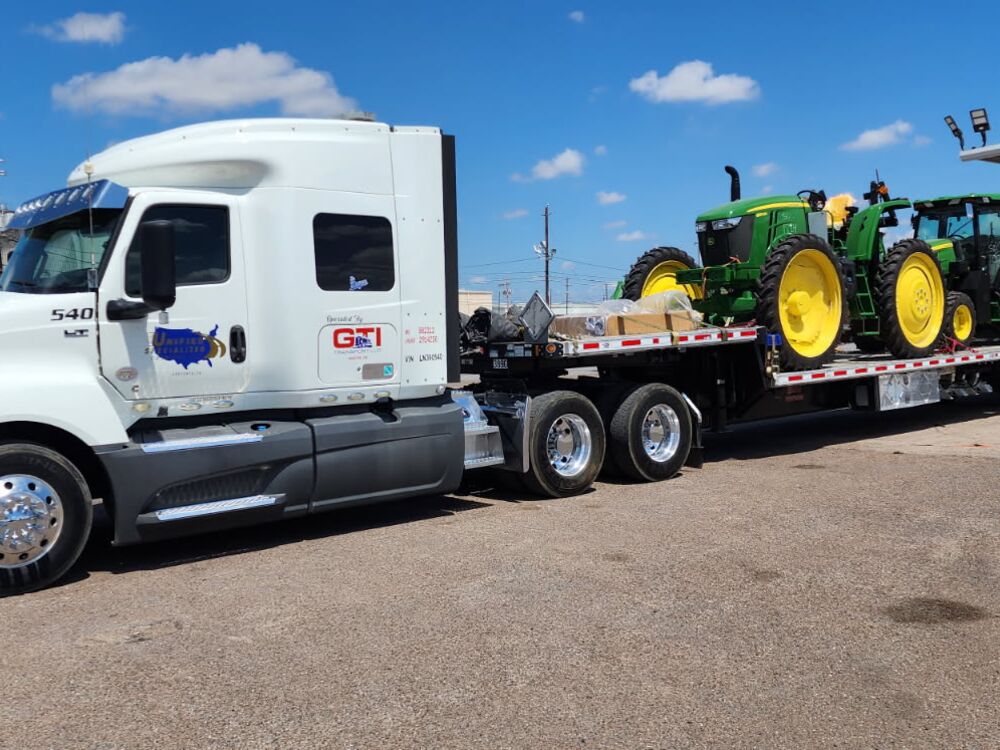
Us. We are putting ourselves first because this is our website, not because we are the biggest carrier on this page. We are not, and it would be silly to pretend otherwise. What we do is a narrower job: 53 ft flatbeds and step-decks running all 48 states, hazmat with over a decade behind it, and heavy freight that is dense and awkward but stays inside legal width, height and length.
If your load needs a nine-axle configuration, a route survey and a police escort, one of the carriers below is the better call and we will say so on the phone. If it is a heavy machine, a run of steel, or a placarded load that needs securing properly and a dispatcher who knows the job, that is our work.
2. Bennett Motor Express
Specialists in oversize and heavy haul since 1974. Bennett reports more than 500 pieces of 9 to 13 axle equipment, with custom configurations running to 19 and even 55 axles for superloads past a million pounds. They hauled over 4,000 loads of structural steel for the Mercedes-Benz Stadium build.
They also run divisions for government and defense work with security-cleared drivers. If your load is genuinely enormous, or it is sensitive, this is the tier you are shopping in.
3. Landstar System
Landstar runs an agent and owner-operator network rather than a single company fleet, and it is one of the largest specialized networks in North America. Recent SEC filings put the network at roughly 8,500 owner-operator trucks and over 17,000 trailers.
The practical advantage is breadth: if you need a wind-blade trailer or an odd configuration in a particular corner of the country, the network usually has one. The trade-off is that service depends on which agent and which owner-operator you land with.
4. Anderson Trucking Service (ATS)
A family business that grew into a large specialized carrier. ATS keeps permitting, routing and safety in-house rather than farming them out, which matters when a load needs a custom route approval through several states.
Their heavy haul division reports 900 or so company trucks and 1,900 trailers, including 100+ assets rated for loads over 100,000 lb.
5. TFI International (formerly Daseke)
TFI bought Daseke in April 2024 for $1.1 billion, absorbing what had been North America's largest specialized open-deck and heavy haul carrier. Daseke brought roughly 4,900 tractors and 11,000 flatbed and specialized trailers, including Lone Star Transportation, its heavy haul arm.
Worth approaching when a project needs a dozen specialized trailers at once rather than a single truck.
6. Mercer Transportation
Mercer runs an owner-operator model across oversize and overweight freight, heavy equipment, military loads and industrial cargo, with logistics and freight management alongside the trucks.
Like Landstar, the model means the driver has skin in the game, and like Landstar, consistency depends on who you get.
7. TMC Transportation
Employee-owned and flatbed-focused, TMC runs a specialized division across the 48 states plus Canada and Mexico, handling construction and agricultural machinery and freight that needs particular loading or offloading.
Strong on standard and lightly specialized open-deck work at volume, rather than million-pound superloads.
If your freight is not open-deck at all
None of the above is the right call for dry van, refrigerated or food-grade freight. DOXA LLC, also in Austin, runs dry van, food-grade, temperature-controlled, LTL, team and hazmat work. Different equipment, different job.
Before you book anyone
Take the carrier's USDOT number, put it into the FMCSA SAFER lookup, and check three things: that the operating authority is active, that insurance is on file, and that the fleet size roughly matches what you were told. It takes two minutes and it rules out most problems. Our own FAQ answers the questions shippers ask us most often.
Then ask for a certificate of insurance naming you, and get the rate and the equipment type in writing before the truck is dispatched.
Figures on this page come from carrier reporting and public filings and were checked in August 2026. Fleet numbers change; verify anything you plan to rely on.
Frequently asked questions
What counts as a heavy haul load?
Freight that exceeds standard legal limits: over 80,000 lb gross, wider than 8 ft 6 in, taller than 13 ft 6 in, or longer than a standard trailer. Anything past those figures needs state permits and often a planned route. Freight that is very heavy but stays inside those dimensions can usually move on a normal flatbed or step-deck without permits.
How do I check a heavy haul carrier is legitimate?
Look up the carrier's USDOT number on the FMCSA SAFER website. It shows operating authority, insurance on file, fleet size and inspection history, all free and public. Ask for a certificate of insurance naming you, and confirm the coverage limit is enough for your freight's value.
Is a bigger carrier always better for heavy haul?
No. Scale matters when your load needs multi-axle equipment, permits across several states, escorts or several trucks at once. For a single heavy but legal-dimension load, a smaller open-deck carrier is often quicker to quote, cheaper, and easier to reach when something changes.
What information should I have ready when asking for a quote?
Dimensions and weight, what the item is, pickup and delivery points, dates, and whether it can be loaded by crane or driven on. For hazmat, the class and UN number. Accurate figures are what make a quote accurate.
How far ahead should a heavy haul move be booked?
For a legal-dimension load, a few days is usually enough. For a permitted oversize move, allow one to two weeks, because permits are issued per state and some are only valid for set travel days and daylight hours.